Dancing on a Broken Ankle (And What It Taught Me About Ignoring My Body)
Setting the Stage: Blackpool Dance Festival
I was in the middle of dancing the quickstep at Blackpool Dance Festival—one of the biggest competitions in ballroom dance—when another couple slammed into me, pinning my legs and twisting my body in the wrong direction. Something snapped. But I kept dancing.
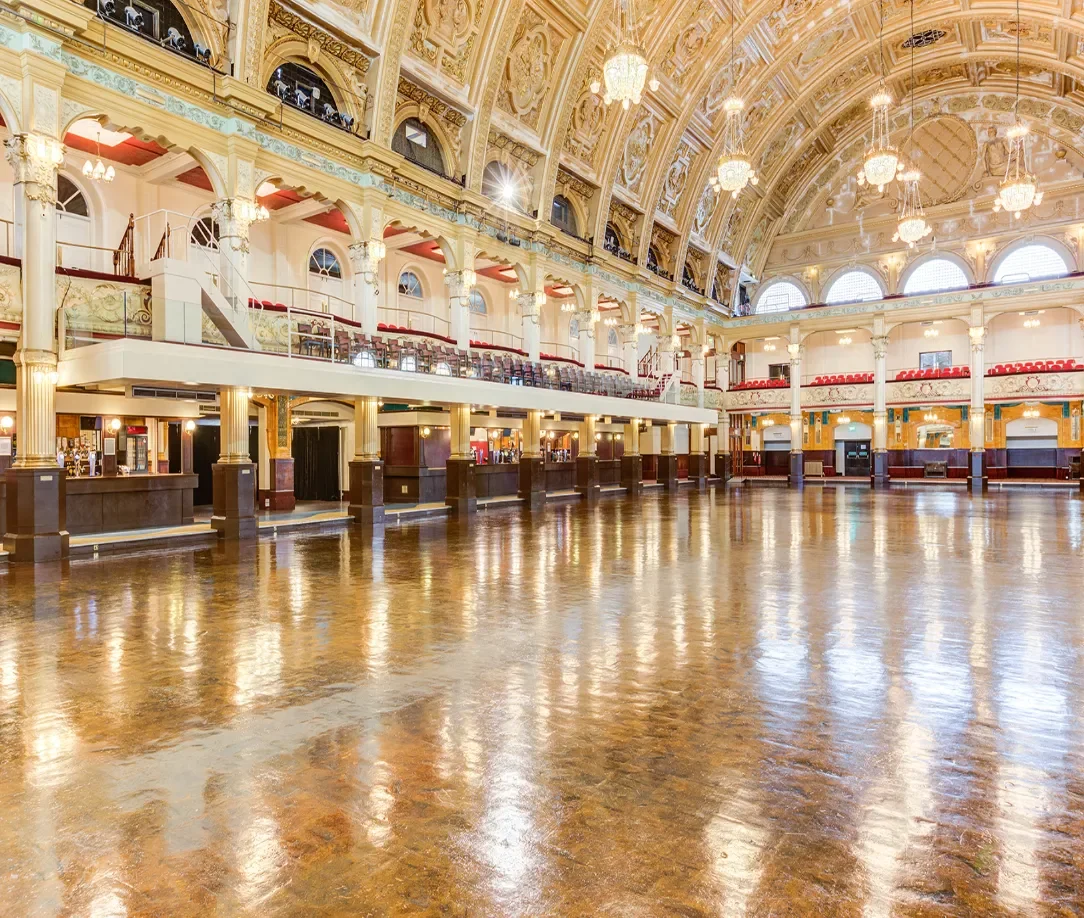
The music is particular to that competition. It's a live band known as the Empress Orchestra and it has its own very specific flavour which you can listen to here. It hasn't changed in about a billion years. This event takes place in the very grand Winter Gardens. Just listening to that music brings me back!
And the setting? The Winter Gardens and this elegant ballroom.
The Competition: High Stakes and Flying Elbows
At the time, I was living in New York City and competing for the U.S. This was my second time at Blackpool this time and first time competing in the professional division. During the Rising Star event and the fifth and final dance of that round—the quickstep—was when I broke my ankle. Or fibula, to be exact.
Some background for your imagination: Blackpool is SUPER competitive. First off, it's like THE competition for ballroom dancers. Your results there can count for a lot. Dancers from all around the world prepare diligently for this event. And there are rounds. Many rounds. And basically the couples who make that first round, proceed to the next round, etc.
So the first few rounds there are a sea of couples on the dance floor. It's packed with couples who've been training day in and day out, who've been preparing for this moment with lots of hard work and planning, and basically travel all the way to Blackpool, England to compete in this competition. Their careers and results are dependent on it. Elbows are out—many dancers don't yield, determined to attract the judges' attention. Some have a 'we stop for nothing and no one' mentality.
There are basic rules that govern dance floor etiquette and movement, meaning each couple must move in a counter clockwise direction and along the "lines of dance". BUT even with these rules in place, some don't follow these lines of dance.
The Moment Everything Changed
Ok, so imagine us all in the grand Winter Gardens with the music of the Empress Orchestra and a sea of couples on the dance floor.
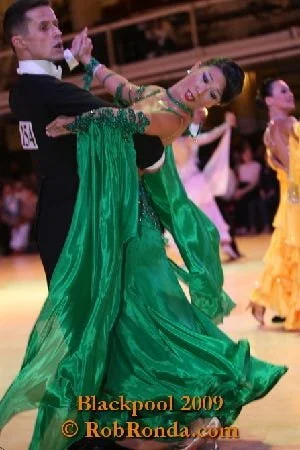
I'm there in this emerald green dress which I absolutely LOVED at the time. (I never did wear it again after this competition since it was tainted with the pain of breaking my poor ankle.)
During the quickstep, another couple—moving in a direction perpendicular to ours—plows into me from the side, completely out of my partner's line of sight. He keeps going. They keep going. Somehow, my legs are pinned, moving with them in a different direction, completely out of my control. The twisting action is what actually causes the fracture. In that moment, I just know that something is wrong. Very wrong. I fall, pulling my partner down with me. The couple who has crashed into me finally stops and apologises, helps me up, and we all get up and keep going and dancing.
And I finish that goddamned dance on my broken ankle. Jumping and skipping and hopping.
It's painful and my foot feels floppy, like it isn't mine. It feels detached. The adrenaline keeps me going and somehow we complete that round.
I collapse when we are off the floor and am unable to stand up afterwards.
Denial & Disappointment
The sad part is we actually do make the next round. They're calling our number for the next round but I'm unable to dance let alone walk. Tears rolls down my face more from the disappointment than the pain, which I'm still not really quite in touch with.
The Rising Star event is at the beginning of the competition week and the Professional event is at the end of the week. The plan was to do both.
I'm not sure if it's resilience or denial (perhaps a bit of both), but the nurse on site tells me it looks like a sprain. At this point my foot is extremely...well, busted. It's swollen and the size of a football. I'm convinced it will heal in the few days in between the events. I spend this time hobbling around with my purple football foot. And because the nurse tells me she thinks it's not broken, I believe her.
I even try dancing on it a few days later, but it's so swollen I can't even get my dance shoes on.
Needless to say, we don't make it back on dance floor. I am heartbroken.
The Aftermath: Reality Sets In
I hobble home—from Blackpool to Manchester by train, then onto my flight back to JFK. It's been a week since I broke my ankle, and it's still swollen, purple, and generally super gnarly. There are even scratches on it I think from lady’s heels when they trotted into and over my foot. Somehow, I still don't feel the pain. Somehow, I'm still convinced it's getting better. At that point, a friend confirms just how busted it is and insists I go to urgent care. Luckily, I'm still completing my Master's degree at NYU, so I have insurance and access to healthcare. They take one look at my foot, put me in a wheelchair, and shake their heads saying, “Why didn't you come in sooner?”
The x-ray technician says he is not allowed to say whether it's broken or not, but warily implies it is most likely broken and again asks me why I didn't come in sooner. They look shocked that I've been walking around on it for a week and even tried dancing on it. They think I'm crazy. The veil of denial slowly starts to lift. Dancing is like 80% of my life at that point, competing and teaching, so the panic of not being able to continue to train and work begins to set it.
Turns out it was a clean break at the fibula.
They refer me to an orthopedic surgeon to determine if I need surgery.
I do a few stress tests and more x-rays in the coming days with the orthopedic surgeon who I learn is actually the surgeon for Cirque du Soleil, and am very grateful to be in his hands. He says I'm lucky I did not make it worse dancing on it and walking around on it for a week. It doesn't require surgery, but a cast, crutches, the works…6 weeks (I think?) on crutches and then rehab and physio.
I did break my right ankle roller skating on a ramp when I was around 10 year old. And now I've fractured my left ankle. I guess now I am even.
The Consequences of Ignoring My Body
In writing this story, I realise how far I've come. And how I've changed.
Because at that time, I had scoffed at doing physio and rehabilitation as the doctor had suggested, and as soon as the cast came off and I could walk again, I put my heels back on and when full on training again. I was young. I figured my ankle would heal itself.
That led to a series of other health problems: A Baker's cyst behind my right knee (about the size of an egg that I had to have aspirated regularly) for over compensating for the stilted movement in my left ankle, which spiralled into consistent and chronic neck spasms, back and abdominal pain…
And then later this attitude led me to burnout, chronic infections.
The Turning Point: Discovering Kinesiology
Fast forward running my own business, navigating a break up in a relationship for which I had moved across the world, the aforementioned chronic pain and a nervous breakdown, which all eventually led me to kinesiology. Kinesiology ultimately changed my life by shifting my relationship with my body, my self, well-being and the world.
I miss dancing sometimes. I miss the music, the expression, the creativity, glamour, challenge, the fun.
I do not miss the politics. The high heels or the hair spray.
(I will never wear heels again. I wear only barefoot shoes these days!)
I like to think I listen to my body more.
I will get an x-ray sooner if I suspect something is off. Or see a doctor immediately. (Like I did earlier this week.)
Then vs. Now: A New Relationship with Feelings
The main difference between Lia then and Lia now is my relationship with my feelings. And anxiety levels. During that time period, I felt incredibly disconnected from my feelings. I was also incredibly anxious. I couldn't even draft an email without overthinking, not wanting to offend someone and determined on having it being worded as perfectly as possible. I don’t remember crying often.
When I retired from dancing and in the early days of my running my digital marketing agency, I kept getting recurring and serious MRSA infections: One in my thigh and the other in my eye. The doctors told me to take a rest saying my immune system was not working properly and to minimise stress in my life. They wrote me a note for home leave.
For most of my life at that point, I believed in pushing through. I had a 'no pain, no gain' mentality and convinced that if I could just keep going, everything would work out. It was a 'store your feelings in a box and get on the with show' approach. And it really took a toll on my physical health.
Learning to Listen: The Body's Wisdom
It was only when I experienced kinesiology that I realised that our bodies know so much more than we give them credit for. That we know so much more than we give ourselves credit for.
There are a plethora of things that keep us disconnected from our feelings, our bodies, our innate knowing, systems, parenting practices, culture.
I can't say I am the most connected now, but much more than before and at least I know when something is up.
(There are times that I unconsciously stuff down uncomfortable feelings, too. Or try to reason, comfort eat or numb them away.)
But now I am much more likely to trust the signs. If there's pain or discomfort, what is it telling me? What is the imbalance? What support do I need? Empathy? Medical advice? Setting a boundary? I consider these options instead of closing my eyes, and hoping it will go away.
When I'm with someone whether it's work or simply hanging out, I ask myself find their presence life giving or life taking? Do I feel icky around them? I tune in now to that as well and take it seriously. I don't doubt myself as much.
The Power of Deeply Feeling-ness
Deeply feeling-ness can be good for you. It can be good for us as a collective. If we all listened to our inner knowing, if we were all connected to it and to feeling deeply, the world would be a better place. Our big feelings wouldn't come out as aggression or harshness towards ourselves and others.
Yes, I believe that some humans are more deeply feeling than others—any fellow HSP's out there?
I also believe deeply feeling-ness is available to everyone—when we nurture it with empathy, provide space for it to exist, and build a culture that truly honours it.
A foot injury earlier this week during a rather vivacious game of freeze tag in my son's gym class raised fears of my foot potentially being fractured. An x-ray showed it was thankfully only a sprain. But being at the hospital and getting that x-rayed really got me reminiscing about this time 16 years ago—and sharing it as my inaugural post!
This is what my Substack is about—Deeply Feeling-ness. In work, in play, in parenting, in wellness, in life. If this resonates with you, subscribe or sign up for email updates from me here and let's explore what it means to truly listen—to our bodies, our feelings, and each other.

Hello there,
I’m Lia, and I’m dedicated to helping humans move through life with more capacity, clarity and connection. As a kinesiologist, I’m here to help you uncover blocks and let go of limiting beliefs that are no longer serving you. If this resonates, I invite you to book a session with me, or learn more about kinesiology here. xx